
For engineers and procurement teams working in oil & gas, petrochemical, and renewables, a fastener is only as trustworthy as the paperwork behind it. Material certificates are the link between a bolt in your hand and proof of what it actually is — the alloy, the heat number, the mechanical test results, and who verified them. Get this wrong, or fail to ask for the right level of certification, and you risk far more than a paperwork gap: you risk pressure integrity, safety, and traceability on a critical connection.
This guide sets out what EN 10204 3.1 and 3.2 certificates are, how they differ, and when each is required across oil & gas, petrochemical, and renewables projects.
What Is EN 10204?
EN 10204 is the European standard that defines the types of inspection documents a manufacturer can issue to confirm that a product — in this case, a fastener — meets the order requirements. It doesn’t set the technical requirements themselves (those come from standards like ASTM, DIN, or BS); instead, it governs how compliance is documented and by whom.
Types 2.1 and 2.2 (declaration of compliance and non-specific test report) exist but are rarely accepted for pressure-containing fasteners in oil & gas and similar applications.
The standard defines several certificate types, but in critical bolting the two that matter most are 3.1 and 3.2.
3.1 Certificates: Manufacturer-Validated Compliance

A 3.1 certificate is issued by the manufacturer and confirms that the products supplied comply with the requirements of the order, based on tests carried out on the actual batch (not just a similar batch or a type test). Critically, the certificate is validated by a party independent of the production department — typically the manufacturer’s own quality department. This is an internal independence requirement, not a third‑party body; the signatory is still the manufacturer’s authorised inspector, typically QA/QC.
A 3.1 certificate will typically include:
- Material grade and chemical composition
- Heat/batch number, providing traceability back to the specific melt of steel
- Mechanical test results — tensile strength, hardness, elongation, and impact values where relevant
- Confirmation of compliance with the specified standard (e.g. ASTM A193 B7, ASTM A320)
This is the certificate most commonly requested for standard critical bolting on oil & gas and petrochemical projects, and it’s the level of documentation Prosper Fasteners provides as standard practice, with full traceability from raw material to finished component.
3.2 Certificates: Independent Third-Party Validation
A 3.2 certificate contains the same technical content as a 3.1 — material composition, batch traceability, and mechanical test results — but with one key difference: validation is carried out and signed by an inspector genuinely independent of the manufacturer. This may be the purchaser’s own authorised representative, or an independent inspection body such as a classification society or notified body.
Because it introduces an independent witness to the testing process, a 3.2 certificate carries a higher level of assurance — and typically a longer lead time and additional cost. It’s reserved for the highest-integrity applications, where an extra layer of verification is contractually or regulatorily required, such as:
- sour service applications under NACE MR0175/ISO 15156 where project or client specifications mandate third‑party witnessed testing
- Subsea and high-pressure/high-temperature (HPHT) equipment
- Projects where the end client’s own specification mandates third-party witnessed testing
- Components destined for classification-society-approved equipment
Why This Distinction Matters on Live Projects
Specifying the wrong certificate type creates real problems downstream. Over-specifying 3.2 certification on standard stock items adds unnecessary cost and lead time to a project where a 3.1 would have satisfied the specification. Under-specifying — accepting 3.1 where a project or client standard calls for 3.2 — can mean a shipment is rejected at goods-in, or worse, that non-conforming material ends up in a pressure-critical joint.
For procurement and QA teams managing multiple suppliers, the safest approach is to confirm certification requirements at the enquiry stage, against the project specification or client standard, rather than assuming a default. Where a project spans multiple certification levels — some components on 3.1, others on 3.2 — batch traceability needs to be tracked carefully so the right certificate follows the right heat number through to site.
Traceability: The Thread That Runs Through Both
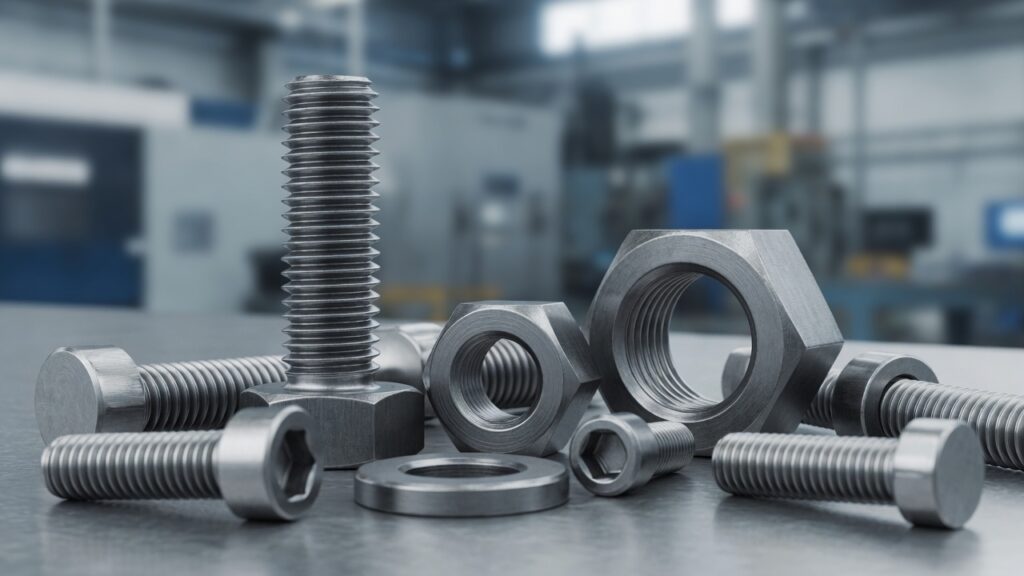
Whether a component is supplied with 3.1 or 3.2 certification, traceability is the constant requirement underneath it. A material test report is only useful if it can be reliably matched to the physical component in front of you — via heat number, batch marking, or another agreed identification method. This is why certification and traceability are treated as a single discipline in critical bolting, rather than two separate boxes to tick.
This matters particularly for fasteners manufactured to standard grades such as ASTM A193 B7 stud bolts, where the consequences of an unverified or mismatched batch in a flanged pressure connection can be severe. It’s also central to grade selection more broadly — for example, when choosing between 316 and 304 stainless steel fasteners for offshore and marine environments, the certificate confirming the actual alloy composition is what gives that selection decision real assurance on site, not just on paper.
How Prosper Fasteners Supports Certification Requirements
Prosper Fasteners supplies standard and bespoke fasteners across oil & gas, petrochemical, and renewables projects, with full 3.1 or 3.2 certification available on request. Every component is sourced from ISO 9001:2015 certified vendors and supplied with full traceability from raw material to finished part, so procurement and QA teams can specify the certification level their project requires with confidence that the paperwork will match the product.
If you’re unsure which certificate type your project specification calls for, or need to source fasteners with 3.1 or 3.2 documentation to a tight project deadline, get in touch with the Prosper Fasteners team — our experience across four decades of oil & gas and petrochemical supply means we can help you get the specification right the first time.
For more on material grades and certification options across our fastener range, see our materials and certification page, or browse our latest technical insights on the blog.